
Temporary Anchorage Devices
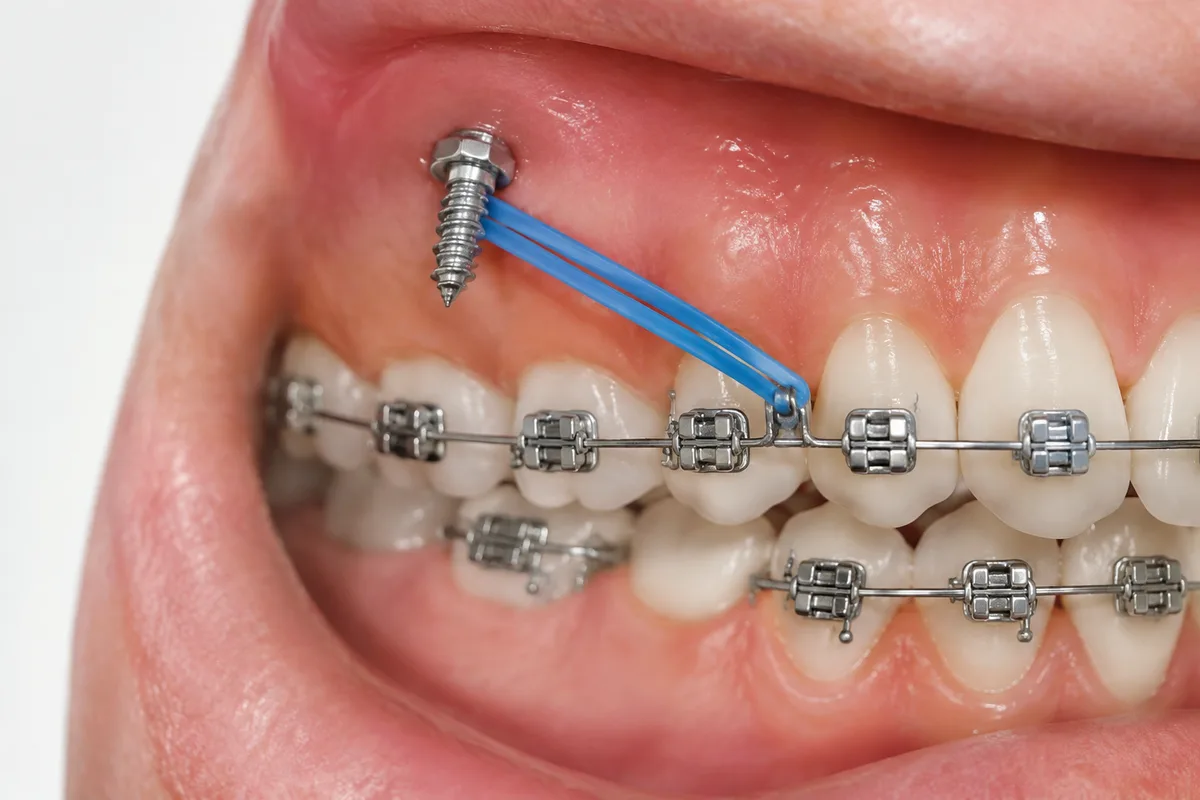
Temporary Anchorage Devices
Temporary Anchorage Devices, often called TADs, are small orthodontic fixtures used to help move teeth into positions that might otherwise be difficult to reach with braces or aligners alone. At 1st Family Dental, TADs are one of the tools our orthodontic team may use as part of a broader treatment plan to give certain tooth movements more precision and control.
What Temporary Anchorage Devices is
A TAD is a small, screw-like device placed temporarily into the bone of the jaw. It acts as a fixed point that does not move, giving braces or aligners something stable to pull or push against. Before TADs became widely available, orthodontists often relied on other teeth, headgear, or elastics worn between the jaws to create the anchorage needed for certain movements — options that could be less predictable or require more patient cooperation.
Because a TAD is anchored directly into bone rather than attached to a tooth, it does not shift the way a tooth might, which allows the orthodontist to direct force exactly where it is needed. TADs are considered temporary: once the tooth movement they were placed to support is complete, the device is removed. They are typically used alongside conventional braces or clear aligners rather than as a stand-alone treatment.
How we use it at 1st Family Dental
At 1st Family Dental, Temporary Anchorage Devices are used to give our orthodontists precise control over tooth movement in cases where that extra anchorage is helpful. This might include closing spaces, adjusting the bite, or moving specific teeth in a direction that would be hard to achieve with braces or aligners alone. Dr. Sameer Al-Obaidi, one of our orthodontists, has training in the use of temporary anchorage devices as part of his broader orthodontic skill set, which also includes fixed appliances, clear aligner systems, and 3D imaging.
TAD placement is planned alongside the diagnostic tools already used for orthodontic care in our offices, including digital x-rays and, where appropriate, 3D imaging, to understand the position of teeth, roots, and bone before a device is placed. TAD-supported movements are typically tracked over the course of treatment using the same digital scanning tools, such as the iTero Element Scanner, used for other orthodontic planning.
What it means for you
For patients, the appeal of TADs is the added precision they bring to tooth movement. Because a TAD provides a fixed anchor point, it can reduce the need for outside appliances like headgear, and it can limit unwanted movement of neighboring teeth that might otherwise happen when using teeth themselves as anchors.
TADs are small, and their placement is a minor, localized procedure. Many patients find the day-to-day experience of wearing braces or aligners with a TAD in place is not much different from orthodontic treatment without one. Clear communication about why a TAD is recommended, what it is expected to do, and how long it will stay in place is part of a well-planned course of orthodontic care.
What to expect during your visit
Before a TAD is placed, your orthodontist will review your treatment plan and explain why the device is recommended for your specific case, along with what movement it is intended to support. The gum tissue in the planned area is typically numbed with a local anesthetic, and placement itself is a brief procedure performed in the office.
After placement, the TAD sits quietly under the gum line or through it, doing its job of holding steady while braces, aligners, or other appliances apply gentle, directed pressure to the teeth. You may feel mild tenderness in the area for a short time afterward, similar to what you might feel after other minor dental procedures. Once the tooth movement it was placed for is complete, the TAD is removed in another short office visit.
Frequently asked questions
Is placing a Temporary Anchorage Device painful?
The area is numbed with local anesthetic before placement, so most patients feel little to nothing during the procedure itself. Some mild soreness afterward is common and typically manageable, similar to minor discomfort after other dental procedures.
How long does a TAD stay in place?
A TAD remains in place only as long as it is needed to support a specific tooth movement, which varies by case and is determined by your orthodontist as part of your overall treatment plan. Once that movement is achieved, the device is removed.
Who is a candidate for TADs?
TADs are considered for orthodontic patients whose treatment plan calls for anchorage that is difficult to achieve with braces, aligners, or elastics alone. Your orthodontist will evaluate your bite, tooth positions, and treatment goals to determine whether a TAD is appropriate for you.
Will a TAD interfere with my braces or aligners?
No — TADs are designed to work alongside braces or clear aligners, providing a stable anchor point that the appliance can use to direct tooth movement. They are a supporting tool within your broader orthodontic plan, not a replacement for it.
If you would like to know whether Temporary Anchorage Devices could be part of your orthodontic treatment, reach out to 1st Family Dental to schedule a consultation.