
IV Sedation
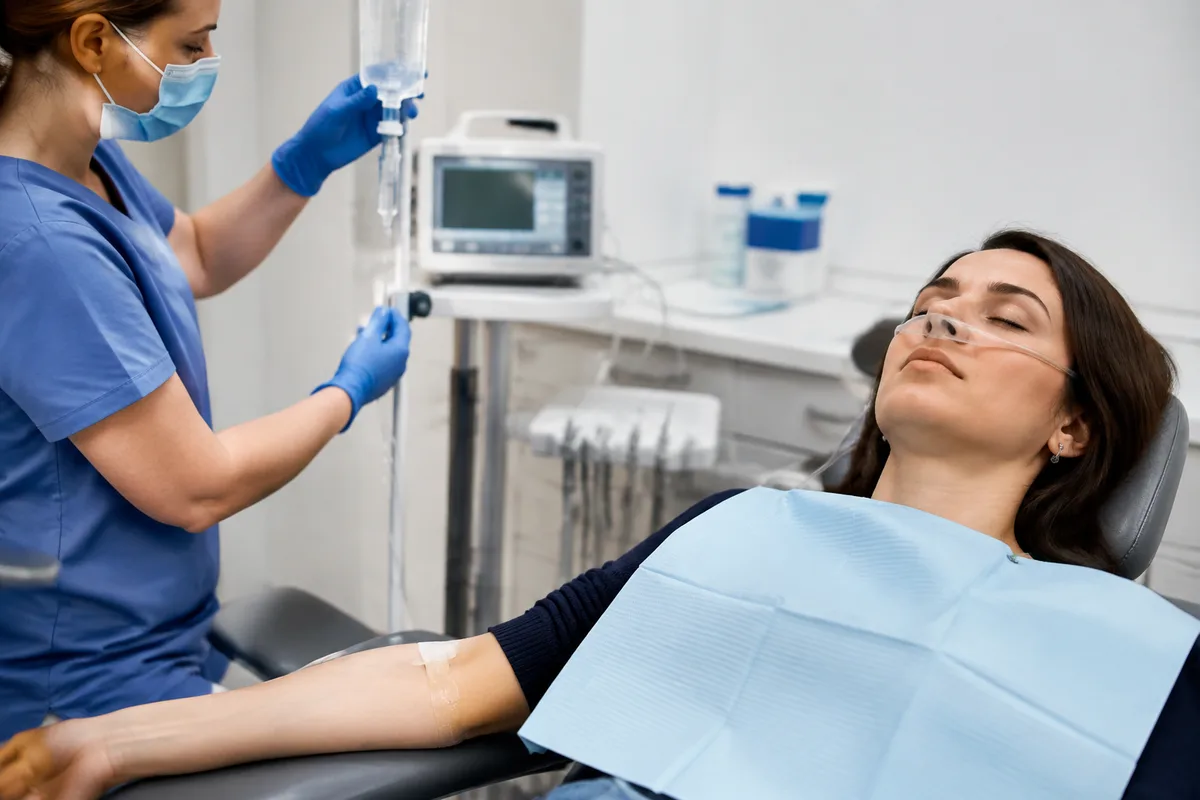
IV Sedation
For longer or more involved surgical appointments, 1st Family Dental offers IV sedation, monitored throughout by our surgical team. It's one option among several ways we help patients stay comfortable and relaxed during more extensive treatment.
What IV Sedation is
IV sedation delivers medication directly into a vein, allowing it to take effect quickly and be adjusted in real time throughout a procedure. Patients typically settle into a deep state of relaxation — some describe it as similar to a light sleep — while remaining able to breathe on their own and respond if needed. This differs from nitrous oxide, which is inhaled and wears off within minutes, and from general anesthesia, which renders a patient fully unconscious.
For dentistry, IV sedation is generally reserved for procedures that are longer, more complex, or more likely to cause anxiety than a routine cleaning or filling. It gives the surgical team more control over a patient's comfort throughout extended time in the chair, without the deeper level of anesthesia used in a hospital operating room.
How we use it at 1st Family Dental
At 1st Family Dental, IV sedation is used for longer surgical procedures and is monitored throughout by our surgical team. This typically supports treatment such as:
- Dental implants and All-on-4 implants — placing implants, including full-arch cases, often takes more time than other procedures.
- Bone grafting and sinus lift — preparatory surgical steps sometimes combined with implant placement in a single visit.
- Wisdom teeth removal and other extractions — especially when multiple or impacted teeth are involved.
- Oral surgery more broadly, where one longer, uninterrupted procedure is more comfortable than several shorter visits.
Surgical planning for these procedures often draws on our 3D Cone Beam CT imaging, which maps bone, nerve pathways, and soft tissue before treatment begins, and can support guided implant surgery so the plan made on the scan carries through precisely in the mouth. Dr. John Hur, our Oral and Maxillofacial Surgeon, completed residency training that included rotations in anesthesia alongside trauma and reconstructive surgery. For milder anxiety or shorter procedures, nitrous oxide remains available as a lighter, faster-wearing alternative.
What it means for you
For patients, IV sedation can turn a procedure that might otherwise feel long or stressful into one that passes with far less awareness of time or discomfort. Because the sedative can be adjusted throughout the appointment, the team can respond to how a patient is doing rather than working from a fixed dose — and this can make it possible to complete more treatment in a single visit, such as combining extractions with implant placement.
Sedation also tends to make communication easier before and after treatment: a calm, comfortable patient has more room to hear explanations and ask questions without anxiety getting in the way.
What to expect during your visit
Before your appointment, you'll typically go through a consultation that reviews your medical history and current medications, along with instructions on eating, drinking, and arranging a ride home. On the day of the procedure, an IV line is placed and your vital signs — heart rate, blood pressure, and oxygen levels — are monitored throughout by the surgical team. Most patients feel very little of the procedure itself and have limited memory of it afterward.
Once treatment is complete, you'll spend some time in recovery as the sedative wears off before you're cleared to leave with your driver. It's normal to feel groggy or unsteady for the rest of the day, so planning to rest afterward is part of preparing for the appointment.
Frequently asked questions
Is IV sedation safe?
IV sedation is a widely used approach to managing longer or more complex surgical procedures. At 1st Family Dental, it is monitored throughout by our surgical team, with vital signs tracked for the duration of the appointment so sedation can be adjusted as needed.
Will I be unconscious?
IV sedation produces a deep state of relaxation rather than the full unconsciousness of general anesthesia. Most patients remain able to breathe independently and respond if spoken to, though many have little or no memory of the procedure afterward.
How long does it take to wear off?
Sedatives given through an IV take effect quickly, but the grogginess they cause can linger for several hours afterward. Because of this, patients need someone to drive them home and typically plan to rest for the remainder of the day.
Who is IV sedation right for?
IV sedation is generally considered for patients undergoing longer surgical procedures, such as implant placement, bone grafting, or wisdom teeth removal, as well as those who feel significant anxiety about dental treatment. A consultation with the surgical team is the best way to determine whether it's the right fit for a particular procedure and patient.
If you have an upcoming surgical procedure or feel anxious about dental treatment, reach out to 1st Family Dental to ask whether IV sedation is a good option for your visit.