
Electronic Apex Locator
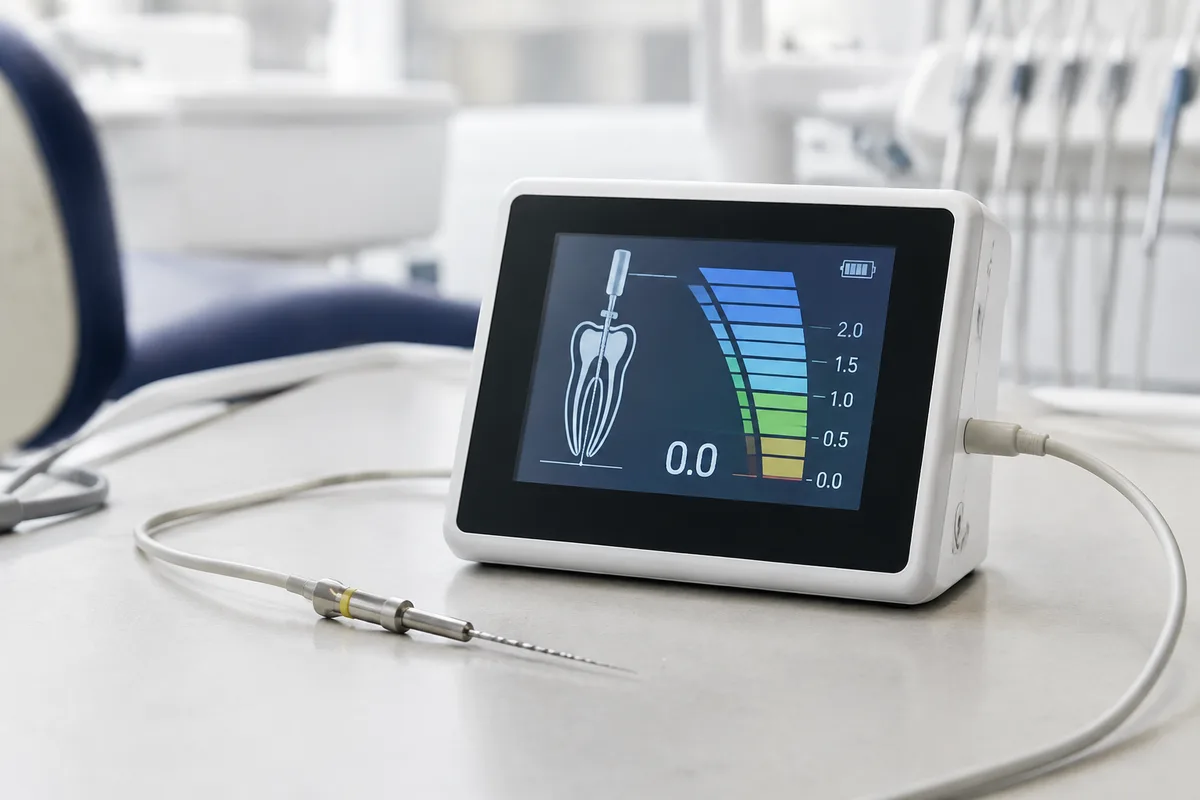
Electronic Apex Locator
An electronic apex locator is a small diagnostic device used during root canal treatment to measure the exact length of a tooth's root canal. At 1st Family Dental, it is one of several tools we use to support careful, accurate endodontic care for patients throughout Chicago.
What electronic Apex Locator is
Every tooth has one or more root canals that run from the crown down to the tip of the root, known as the apex. Before a root canal can be cleaned and filled properly, the dentist needs to know precisely how long that canal is. An electronic apex locator determines this by sending a very small, safe electrical signal through a file placed inside the canal and measuring the resistance as it approaches the root tip.
Historically, dentists relied mainly on a series of x-rays taken at different stages of the procedure to estimate canal length. That method works, but it can require multiple exposures and still leave some room for interpretation. An apex locator gives a real-time, numeric reading as the file moves through the canal, which helps confirm length more directly and can reduce how many additional x-rays are needed during treatment.
How we use it at 1st Family Dental
When root canal treatment is needed, our dentists use the electronic apex locator alongside rotary endodontic instruments to clean and shape the canal efficiently. The locator helps confirm working length as the canal is being prepared, so the file reaches the proper depth without going past the root tip or stopping short of it.
This measurement works together with digital x-rays, which our team also reviews during treatment, to build a complete picture of the tooth's anatomy. Because the apex locator provides continuous feedback rather than a single static image, it is typically used at key points during cleaning and shaping rather than replacing x-rays entirely — the two methods complement one another.
What it means for you
For patients, the main benefits of an electronic apex locator are accuracy and efficiency during root canal treatment. Some general advantages include:
- Precise measurement — helps the dentist identify canal length directly, rather than relying solely on estimation.
- Fewer x-rays — real-time readings can reduce how many additional images are needed mid-treatment.
- Supports thorough cleaning — knowing the correct working length helps ensure the canal is treated along its full length.
- Straightforward for the patient — the device itself involves no discomfort beyond what is already part of root canal treatment.
These are general benefits of the technology and how it is typically applied in root canal care; they describe what the equipment does, not a guarantee of outcome for any individual case.
What to expect during your visit
If you need a root canal, your visit will start the way any root canal appointment does — with an exam, review of your digital x-rays, and local anesthetic so the area is numb and comfortable. Once the tooth is accessed, the dentist places a small file connected to the apex locator into the canal. A clip is attached to your lip or cheek to complete the circuit, and the device gives a reading as the file advances.
You won't feel the electronic signal itself — it operates at a level well below what could be sensed. The measurement step adds only a short amount of time to the overall procedure, which is otherwise similar in length to a standard root canal appointment. Afterward, the canal is cleaned, shaped, and filled, and the tooth is typically restored with a filling or crown at a follow-up visit.
Is an electronic apex locator safe?
Yes. The electrical signal used is very low level and is a standard part of modern endodontic treatment. It does not use radiation, unlike x-rays, which is one reason it can help reduce the number of x-ray images taken during a procedure.
Will I feel anything from the device?
No. The signal used to measure canal length is not perceptible to patients. Any sensation during the appointment comes from the root canal procedure itself, which is performed under local anesthetic.
How often is it used during treatment?
It is typically used at one or more points while the canal is being cleaned and shaped, to confirm working length as instruments move through the canal. The exact number of measurements can vary depending on the tooth and the case.
Who is it suitable for?
An electronic apex locator can be used for most patients undergoing root canal treatment, regardless of age. Your dentist will determine the appropriate approach for your specific tooth and situation as part of your treatment plan.
If you have questions about root canal treatment or the electronic apex locator, reach out to 1st Family Dental — we're happy to talk through what to expect at your visit.